Showing posts with label Reading. Show all posts

Thursday, April 2, 2015

"The Photograph as Contemporary Art" - Chapter 6: Moments in History - Learning Points

The course material includes also "The Photograph as Contemporary Art", a very interesting book written by Charlotte Cotton published by Thames and Hudson (London 2014 Third edition). As I decided to do for my practical course, I would like to keep track of my learning points as I gradually go on reading the book reporting the most important sentences by the above author.
No copyright infringement intended - photographs will be removed immediately upon request.

This chapter considers how photography can bear witness to the ways of life and events of the world.
Contemporary art photographers have, in the main, taken an anti-reportage stance:slowing down image making, remaining out of the hub of action and arriving after the decisive moment.
Rather than being caught up in the chaotic midst an event or at close quarters to individual pain and suffering, photographers choose instead to represent what is left behind in the wake of such tragedies, often doing so with styles that propose a qualify perspective.

Zarina Bhimji works with film and photography to recount the physicality and time of unidentified spaces and in doing so she considers the way in which images can resonate with general narratives of elimination, extermination and erasure.
She chooses forms that function as allegories which, through their extreme economy of means, always remain open-ended and unresolved.
She described her project about Uganda as learning to listen to difference, listening with the eyes, listening to changes in tone, differences in colour.
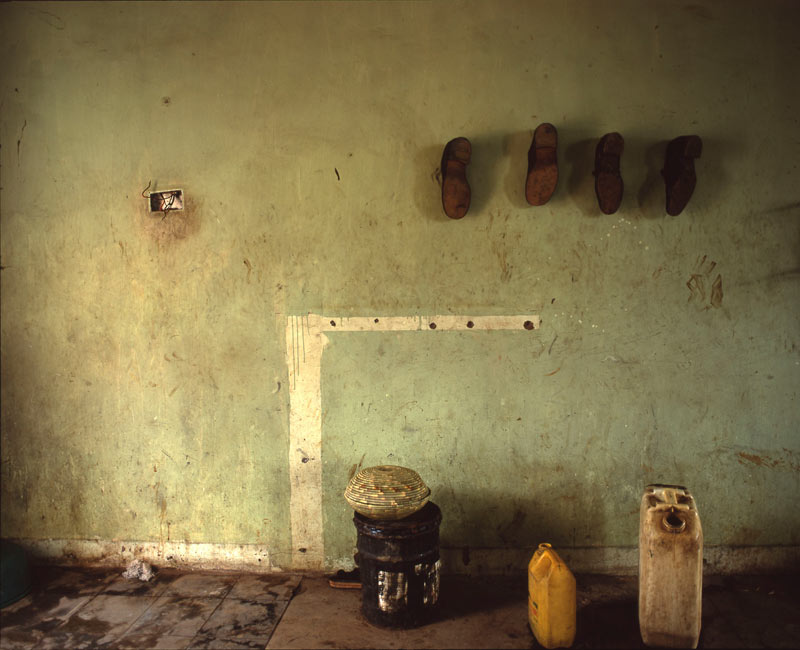

Zarina Bhimji - Memories Were Trapped Inside the Asphalt - 1998-2003

Fazal Sheikh has primarily photographed individuals and families living in refugee camps.
He uses black and white photography which both makes a declaration of resistance against the seductive fashion in art of colour prints and identifies the work as documentary portraiture with a serious intent.


Fazal Sheikh - Halima Abdullai - 2000

Visualising the maintenance of identity and self-respect in challenging circumstances is strongly present in South African photographer Zwelethu Mthethwa's extensive documentation of the homes and people in the shanty towns on the outskirts of Cape Town.
The increased toleration in the 80s of black people's migration out of the apartheid system's reserves led to a massive influx of rural blacks in search of work to these makeshift communities.
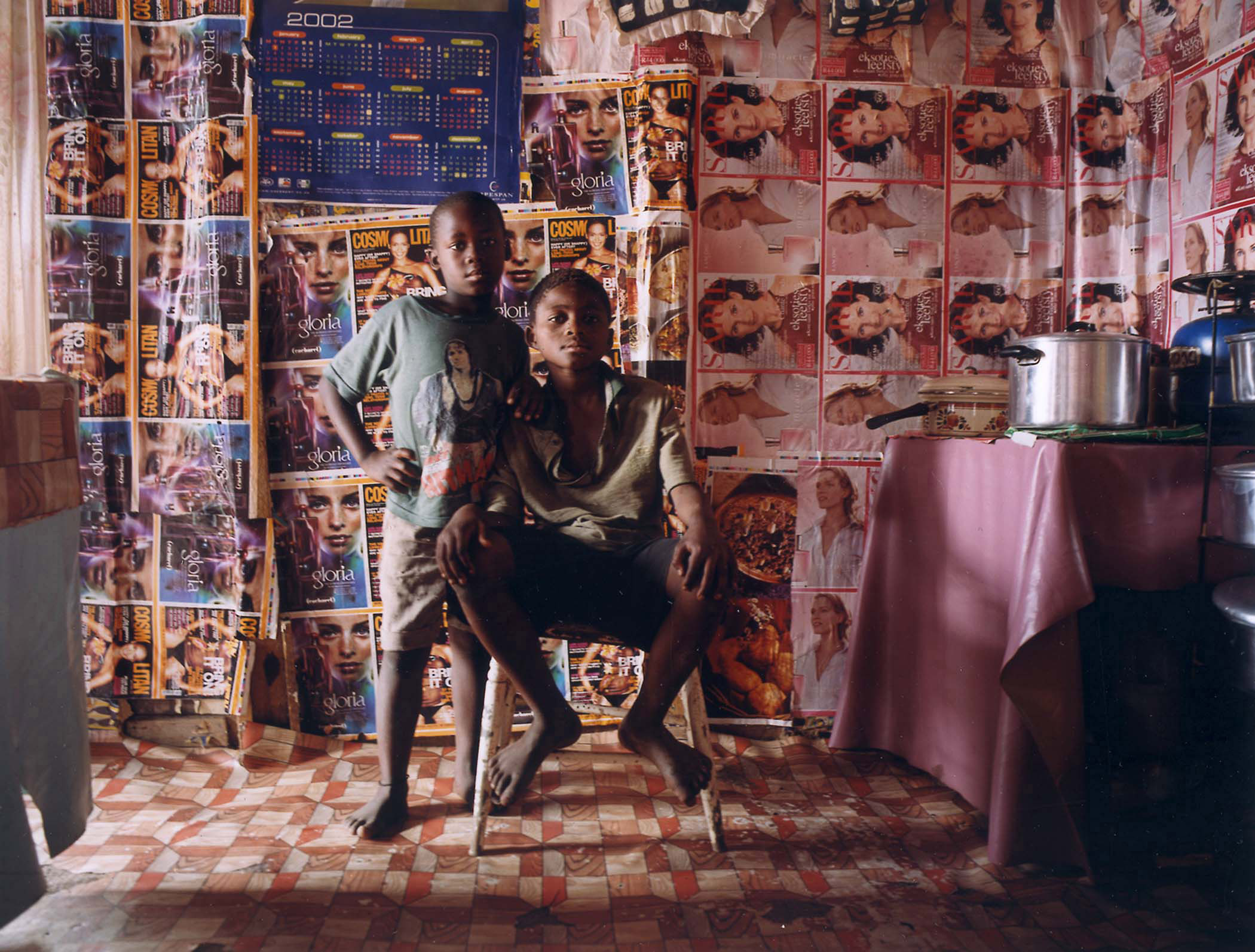

Zwelethu Mthethwa - Untitled - 2003

In the early 2000s Adam Broomberg and Oliver Chanarin gained access to different international communities in their roles as photographers and creative editors of Benetton's Colors magazine (one of the few photography magazines in recent years to have explicitly addressed global issues).
They edited issues on social themes such as the treatment of mental illness, refugees and the penal system.


Adam Broomberg and Oliver Chanarin - Timmy, Peter and Frederick, Pollsmoor Prison - 2002

The highly influential British photographer Martin Parr has also consistently tested the boundaries of documentary style.
Parr has employed a number of visual formats for his documentary projects, and in the mid 1990s began using a hand-held camera with flashlight in combination with a macro lens that focuses close up on a subject.
Parr's "Common Sense" creates the brash and graphic depiction of everyday objects and observations for which he is well known.
The overall theme of the series is the vernacular fashioning of junk food, tacky souvenirs and package holidays.
There is a democracy of sorts in Parr's project, as every subject is given the same visual treatment: closely cropped, flash lit, and the heightened colour of a snappy snap, whether an image shows the back of a person's head, a plate of food or a prized possession.
Parr's "Common Sense" epitomises photography promiscuity - the taking of hundreds of photographs, which in their combination offer one dynamic and subjective image of the world.


Martin Parr - Benidorm, Spain - 1997

Wednesday, February 25, 2015

"The Photograph as Contemporary Art" - Chapter 5: Intimate life - Learning points

The course material includes also "The Photograph as Contemporary Art", a very interesting book written by Charlotte Cotton published by Thames and Hudson (London 2014 Third edition). As I decided to do for my practical course, I would like to keep track of my learning points as I gradually go on reading the book reporting the most important sentences by the above author.
No copyright infringement intended - photographs will be removed immediately upon request.


This chapter looks at how narratives of domestic and intimate life have been presented in contemporary art photography.
The use of seemingly unskilled photography is an intentional device that signals the intimacy of the relationship between the photographer and his or her subject.
This kind of art photography, on the other hand, while embellishing the aesthetics of family snaps, often substitutes the emotional flip-side for their expected scenarios: sadness, disputes, addiction and illnesses.
It also takes as its subjects the nonevents of daily life: sleeping, talking on the phone, traveling by car, being bored and uncommunicative.

Nan Goldin sets the standards by which intimate photography and its creators are judged.
Goldin's first photographs, which she took in her late teens, were a series of black and white images entitled "Drag Queens" which empathetically portrayed the daily lives of two drag queens with whom she lived and their social circle.
In her " The Ballade of Sexual Dependency" she states the phycological necessity for her to make photographs of her loved ones.
Her description of the effect of her sister's suicide at the age of eighteen vividly justifies the sense of urgency with which she photographs what is emotionally significant to her, as a way of holding onto her own version of her history.
In the early 1990's, with the publication of "I'll be your mirror", Goldin's photographs of those around her counterbalanced celebration with loss.
Her intense record of the impact of HIV and AIDS-related illness, drug addiction and rehabilitation on her and her friends's lives offered art audiences a profound engagement with these social issues, spelt out in personal terms.
"The other side" showed transvestites and transexuals in cities she visited.
Goldin's photographs reached the art world almost serendipitously: her initial motivation was to take these photographs for personal reasons rather than to make a high-profile career as a photographer.


Nan Goldin - Greer and Robert on the bed - 1953

Larry Clark's books "Tulsa", "Teenage Lust" and "The Perfect Childhood" are all centred on a self-destructive combination of sex, drugs and guns in the hands of out-of-control young people.
The sense of Clark's being an insider, recording the teenagers' nihilistic progress into adulthood, is emphasised in an essay in which he both describes experiences from his own life that mirror the events in his photographs and declares his motivation as an adult to take the photographs he wished he had made as a child.


Larry Clark - Untitled - 1972

Corinne Day published a personal chronicle of her life in the late 1990s, focusing on the period when she suffered a life-threatening seizure that led to hospitalisation and the discovery of a brain tumour.
In "Diary" images of Day in the hospital leading up to an operation to remove the tumour and her recovery appears like staccato notes through the book sequence of photographs of the highs and lows of her social circle.


Corinne Day - Untitled - 2000


Corinne Day - Tara Sitting on the Loo -1995, 2000


The meteoric rise of British artist Richard Billingham began in the early 1990s when he started to create a memorable record of his family life.
"Ray's a Laugh" was published with a minimal amount of text and a high-impact sequence of images of Ray (his father) drinking home-brewed beer and falling over, Liz (his mother) and Ray fighting, and Jason (his brother) playing computer games, all in their cramped and untidy council flat in the West Midlands.


Richard Billingham - Untitled - 1994

American artist Larry Sultan published his book "Pictures from Home" in 1992.
The book is an evocative study of his mother and father.
some of the photographs are posed, and Sultan describes these as images he traded or negotiated with his parents as he won their agreement to be photographed while their undertook household chores.


Larry Sultan - Argument at the Kitchen Table - 1986 

When talking about his formative experiences of photography, Colin Gray describes the camera as being a symbolic control over, and way of visualising, the bonds within his family.
The series marks the shifts in his old parents routines, such as the increasing number of visits they make to hospitals and to their church.


Colin Gray - In Sickness And In Health - 2002


Tuesday, July 15, 2014

"The Photograph as Contemporary Art" - Chapter 4: Something and Nothing - Learning points

The course material includes also "The Photograph as Contemporary Art", a very interesting book written by Charlotte Cotton published by Thames and Hudson (London 2014 Third edition). As I decided to do for my practical course, I would like to keep track of my learning points as I gradually go on reading the book reporting the most important sentences by the above author.
No copyright infringement intended - photographs will be removed immediately upon request.

The photographs in this chapter show how non-human things, often quite ordinary, everyday objects, can be made extraordinary by being photographed.
These photographs retain the thing-ness of what they describe, but their subjects are altered conceptually because of the way they have been represented.
Through photography, quotidian matter is given a visual charge and imaginative possibility beyond its everyday function.
The iconography for this strand of photography includes objects balanced and stacked, the edges or corners of things, abandoned spaces, rubbish and decay, and fugitive or ephemeral forms, such as snow, condensation and light.
There is no such a thing as an unphotographed or unphotographable subject.
This strand of photography has been driven by related attempts to make art from the matter of daily life, by breaking the boundaries between the artist's studio, the gallery and the world.
Rather than asking how and by whose hand the work of art was made, the question becomes: How did this object come to be here? And what act or chain of events brought it into focus?

Peter Fischli and David Weiss in their Quiet Afternoon series show table-top assemblages of mundane items that seem to have been found close at hand in the artists' studio.
They created sculptural forms by fixing and balancing these objects together and then photographing them against dull backgrounds with raking shadows, lending a comic drama to their consciously unsophisticated temporary sculptures.


Peter Fischli and David Weiss - Reibeisen Mit Karotte Und Zucchini, 1984-1985

Gabriel Orozco's art is full of impossible, witty and imaginative games. 
Whether in the form of photographs, collages or sculptures, or as an animated conversation between these mediums, his installations and exhibitions display work that, with a remarkable economy of means, offer exciting and playful conceptual journeys.
In his Breath on Piano, on one level the photograph can be seen as the documentation of the highly fugitive act of breathing onto the seamlessly shiny surface of the piano top.
On the other, it makes us see the image as image, as forms on a surface, which is a fundamental condition of a photographic print.


Gabriel Orozco - Breath on Piano, 1993

For more than thirty years, British artist Richard Wentworth has photographed the sign and debris of urban streets.
The objects are often redundant from their original function, reused or abandoned, and through photography they gain new, sometimes comic characterisations.


Richard Wentworth - King Cross, London, 1999

German artist and director Wim Wenders uses still photography when a site carries its own story and does not require him to construct one cinematically.
In Wall in Paris, Texas the cracks in the road and the plaster on the side of the building that has fallen away to reveal the brickwork beneath create an allegory of the deterioration and fragility of the place, emphasised by the fraught diagonal lines of the power cables dissecting the image.


Wim Wenders - Wall in Paris, Texas, 2001

Tracey Baran's highly sensual photograph, Dewy, of an etched glass still wet with moisture and placed on a widow sill, light falling onto it through foliage, is a classic still life.
The sense of physicality in this uncontrived combination of planes and forms is delicately mapped.


Tracey Baran - Dewy, 2000

Jeff Wall's Diagonal Compositions no. 3 may at first seem to be an unusual work for him because of the absence of a cast of actors or impressive mise-en-scène.
Wall's careful construction of a grouping of peripheral things prompts questions about our own relationship with photographs: Why are we looking at this? At what point in history and our own lives did a corner of a floor represented in a photograph become iconic, worthy of our attention?
To what degree does it need to be abstracted by the seemingly innocent frame in order for us to recognise this grouping of non-subjects to be still life?
The beauty of Wall's photography is that, while it raises these complex questions, it still satisfies us a works of art.


Jeff Wall - Diagonal Composition No. 3, 2000

German artist Uta Barth's series Nowhere near pares down its subject matter to the spaces between things.
Here she focuses on a window frame and the view beyond, whose blurred forms mark the boundary of what is outside the photograph's visual range.
Thus we are made hypersensitive to what we edit out or do not look at, and so do not define as a subject or a concept that can be seen.


  Uta Barth - Untitled, Nowhere Near (nw 6), 1999


Sunday, July 13, 2014

"The Photograph as Contemporary Art" - Chapter 3: Deadpan - Learning points

The course material includes also "The Photograph as Contemporary Art", a very interesting book written by Charlotte Cotton published by Thames and Hudson (London 2014 Third edition). As I decided to do for my practical course, I would like to keep track of my learning points as I gradually go on reading the book reporting the most important sentences by the above author.
No copyright infringement intended - photographs will be removed immediately upon request.

The third chapter focuses on the deadpan aesthetic: a cool, detached and keenly sharp type of photography.
The emphasis is on photography as a way of seeing beyond the limitations of individual perspective, a way of mapping the extent of the forces, invisible from a single human standpoint, that govern the man-made and natural world.
The deadpan became popular in the 90s, especially with landscape and architectural subjects.
The deadpan we see today is often characterised as "Germanic". This moniker refers not only to the nationality of many of the key figures but also to the fact that a significant number were educated, under the tutelage of Bernd Becher, at the Kunstakademie in DĂĽsseldorf, Germany.
Albert Renger-Patsch, August Sander and Erwin Blumenfeld are the most mentioned forefathers of today's deadpan photography.

Andreas Gursky adds to his oeuvre with each satisfyingly complete picture, rather like a painter does, so every photograph he releases has a good chance of contributing to the high reputation enjoyed by his work asa whole.
He works within connected themes and releases photographs that stand as discrete visual experiences.
His immaculate consistency is an undeniable element of his commercial and critical success.
Gursky often places us so far away from his subjects that we are not part of the action at all but detached, critical viewers.
What we are given is a mapping of contemporary life governed by forces that are not possible to see from a position within the crowd.


Andreas Gursky - Chicago Board of Trade II, 1999

The German artist Matthias Hoch's typology of contemporary life has typically centred on architectural detail and interiors.
In Leipzig #47 there is an evident sense of geometry and mapping.
The light emanating from the screen flattens the poles in the foreground, emphasising the nature of the space that determines the subtle drama of the scene.


Matthias Hoch - Leipzig #47, 1998

Jacqueline Hassink applied to photograph ten rooms in a hundred American and Japanese corporations (including the CEO's home offices, archives, lobbies, boardrooms and dining rooms).
The refusals and acceptances Hassink received feature on a graph that accompanies the photographs of the rooms to which she gained entrance.


Jacqueline Hassink - Mr Robert Benmosche, CEO, Metropolitan Life Insurance, NY April 20 2000, 2000

Alex HĂĽtte introduced a new element to his deadpan photography in the mid 90s with a series of photographs of cities taken at night with long exposure times.
These photographs are presented as transparencies held in front of reflective surface, creating a glistening effect in the illuminated areas of the image where the mirror-like backing is visible.


Alex HĂĽtte - The Dog's Home Battersea, 2001

For more than thirty years American photographer Richard Misrach has created numerous bodies of landscape and architectural photography, with a particular focus on the American West and the tradition of its representation.
His political and ecological views come through his images of sites in the aftermath of landscape devastation and man's destruction of natural resources.


Richard Misrach - Battleground Point #20, 1999

What interests John Riddy is photography's capacity to conflate time and its ability to evoke the history of a space. 
In Maputa (Train), the turquoise paintwork and the benches become the fading signs of a moment in the place's colonial past.
Present time is shown in the train carriage at the centre of the image, an element we know will soon depart without a trace.


John Riddy - Maputa (Train), 2002

The chapter draws to a close by considering artists who use the depersonalised deadpan style in portraiture.
One of the most influential portrait photographers of the 80s was German artist Thomas Ruff.
Ruff began photographing head-and-shoulder images of his friends, reminiscent of passport photographs, although considerably larger in format.
He asked his subjects to remain expressionless and look straight at the camera.
At the same time as offering great detail in the sitters' faces, right down to the hair follicles and pores in their skin, the work's blank expressions and lack of visual triggers, such as gestures, confound our expectations of discovering a person's character through their appearance. 


Thomas Ruff - Portrait


Sunday, June 1, 2014

"The Photograph as Contemporary Art" - Chapter 2: Once Upon a Time - Learning points

The course material includes also "The Photograph as Contemporary Art", a very interesting book written by Charlotte Cotton published by Thames and Hudson (London 2014 Third edition). As I decided to do for my practical course, I would like to keep track of my learning points as I gradually go on reading the book reporting the most important sentences by the above author.
No copyright infringement intended - photographs will be removed immediately upon request.

The chapter 2 considers the use of storytelling in contemporary art photography.
This area of photographic practise is often described as tableau or tableau-vivant photography, for pictorial narrative is concentrated into a single image: a stand alone picture.

One of the leading practitioners of the staged tableau photograph is the Canadian artist Jeff Wall.
He describes his work as having two broad areas. One is an ornate style in which the artifice of the photograph is made obvious by the fantastic nature of his stories. The other is the staging of an event that appears much slighter, like a casually glanced-at-scene.
He is similar to a film director who imaginatively harnesses collective fantasies and realities.


Jeff Wall - Insomnia, 1994

Philip-Lorca diCorcia's "Hollywood" is a series of portraits of men whom diCorcia met in and around Santa Monica Bd in Hollywood and asked to pose for him.
The titles of each photo tell you the name, his age, where he was born and how much he was paid to pose.
The pictures encourage a kind of storytelling in the viewer's mind.

Philip-Lorca diCorcia - Eddie Anderson; 21years old; Houston, TX; $20, 1990-92

Tableau photography often refers to specific works of earlier art.
The British artist Sam Taylor-Wood's "Soliloquy I" shows the figure of a beautiful young man expired on a sofa, his right arm hanging lifelessly to the floor.
This pose emulates a popular work by the Victorian painter Henry Wallis (The Death of Chatterton).
Taylor-Wood consciously revives the idealism bound up in Wallis's painting.


Henry Wallis - The Death of Chatterton, 1856


Sam Taylor-Wood's - Soliloquy I, 1998

Dutch artist Liza May Post's photographs and films have magical, dream-like qualities.
In "Shadow" both figures are dressed in androgynous clothes that hide their gender and age.
The details in the photo are hyper-real and, like a surreal dream, their combination and visual charge leave the narrative open to the viewer's interpretation.


Liza May Post - Shoulderblades: Shelter, 1996

The Cuban artist Deborah Mesa-Pelly recasts fairy tales and popular stories with young female characters and with disturbing results.
Mesa-Pelly stages situations that could be scenes from the stories as they are conventionally told, but dramatised and given a sinister edge by her lighting and voyeuristic camera angles.


Deborah Mesa-Pelly - Legs, 1999

Anna Gaskell's photographs share an intense storytelling quality that combines a number of the common devises of tableau photography: a cast of children, sometimes with their faces obscured, their play gone awry or turned nasty.
The physical beauty of the prints, combined with the moral ambiguity of the narrative, makes for an unnerving visual pleasure.


Anna Gaskell - Untitled #59, 1999

British artist Christopher Stewart photographs private security firms finding contemporary allegories for Western insecurity and paranoia.


Christopher Stewart - United States of America, 2002

German artist Rut Blees Luxemburg uses the elemental devises of lighting and water reflections to create magnificent amber imagery of urban architecture.
In "In Deeper" the viewer is placed within the scene at the top of the steps of a river embankment.
Footprints are left in the wet silt on the steps leading into the luminescent river, revealed by raking lighting.


Rut Blees Luxemburg - In Deeper, 1999


Friday, April 18, 2014

"The Photograph as Contemporary Art" - Chapter 1: If This Is Art - Learning points

The course material includes also "The Photograph as Contemporary Art", a very interesting book written by Charlotte Cotton published by Thames and Hudson (London 2014 Third edition). As I decided to do for my practical course, I would like to keep track of my learning points as I gradually go on reading the book reporting the most important sentences by the above author.
No copyright infringement intended - photographs will be removed immediately upon request.

All the photographs in this chapter evolve from a strategy or happening orchestrated by the photographers for the sole purpose of creating an image.
The central artistic act is one of directing an event specially for the camera.
The roots of such an approach lie in the conceptual art of the mid-1960s and 1970s.
The act depicted in the photograph is what is artistically important.

In 1917, Marcel Duchamp, the father of conceptual art, submitted a factory-made urinal to the Armory Show in New York on the basis that art could be anything the artist designated it to be.
Today, only photographs remain of the original "Fountain", taken by Alfred Stieglitz.


Alfred Stieglitz - Fountain by Marcel Duchamp, 1917

French artist Sophie Calle's art works conflate fact and fiction, exhibitionism and voyeurism, and performance ans spectatorship.
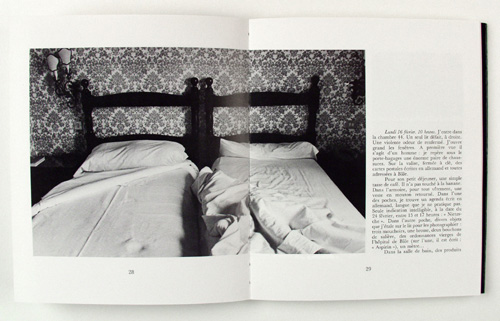
For her work "The Hotel" Calle took a job as a chambermaid in Venice and during her daily cleaning of the bedrooms, she photographed the personal items of their temporary inhabitants, discovering and imagining who they might be.


Sophie Calle - L'Hotel, 1984

Photography's role in making and showing alternative realities has also been used in less specific but equally intriguing ways.
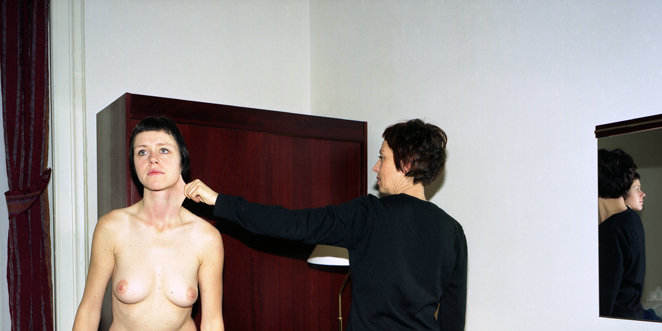
Melanie Manchot's series "Gestures of Demarcation" shows the artist expressionless and static asa second figure pulls the elastic skin of her neck.
This scene is not a performance being photographed but an act created for the express purpose of being photographed.


Melanie Manchot - Gestures of Demarcation VI, 2001

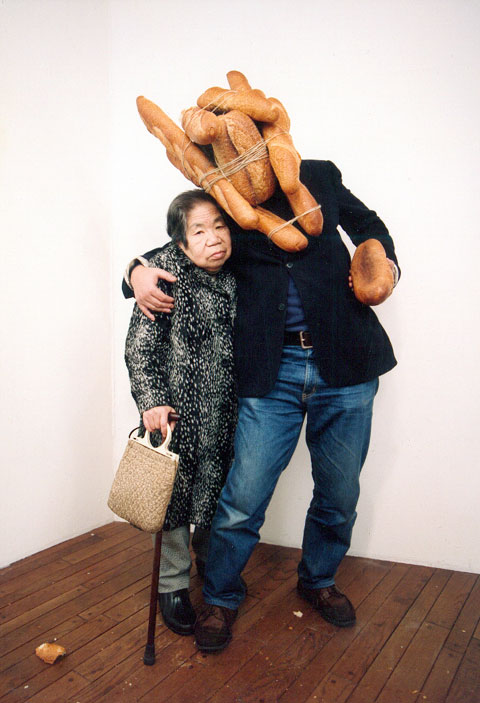
"Bread Man" is the performance persona of the Japanese artist Tatsumi Orimoto who hides his face under a sculptural mass of bread and then performs normal everyday activities.
The photographs representing these absurdist interventions are dependent on people's willingness and resistance to break with their daily activities in order to interact and be photographed. 


Tatsumi Orimoto - Bread Man Son and Alzheimer Mama, 1996

The capacity of photo-conceptualism to dislodge the surface of everyday life through simple acts occurs in British artist Gillian Wearing's "Signs that say what you want them to say and not signs that say what someone else wants you to say".
For this work, Wearing approached strangers and the streets of London and asked them to write something about themselves on a piece of white card; she then photographed them holding their texts.
By making the thoughts of her subjects the focus of the portraits, Wearing proposes that the capturing of the profundity and experience of everyday life is not intrinsic to the traditional styles or compositions of the documentary photograph, but is more effectively reached through artistic intervention and strategy.


Gillian Wearing - Signs that say what you want them to say and not signs that say what someone else wants you to say, 1992 

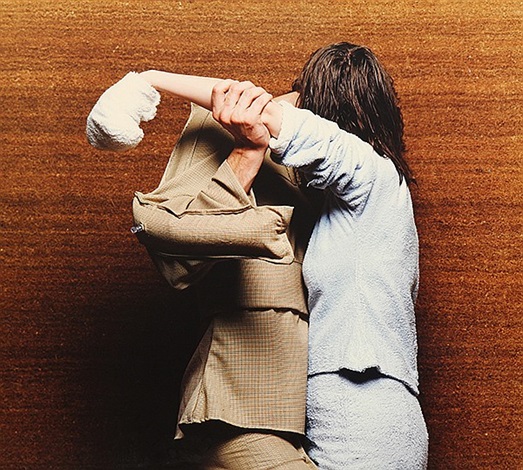
In Mona Hatoum's "Van Gogh's Back" we jump mentally from the swirls of hair on the men's wet back to the starry skies of Van Gogh's swirling paintwork.
The enjoyment of such a photograph is based on our shift from registering a photographic image as a three-dimensional scene and that of a two-dimensional, graphic representation of the swirls of wet hair that we connect, via Van Gogh, to a patterned sky.


Mona Hatoum - Van Gogh's Back, 1995

The American photographer and poet Tim Davis's series "Retail" depicts the darkened windows of American suburban houses at night, with windows reflecting the neon signs from fast-food joints.
The photographs reveal a subliminal imposition of contemporary consumer culture onto domestic life.
With the repetition of this night time phenomenon express his theory of the contamination of our privacy and consciousness by commercialism.


Tim Davis - McDonalds 2, Blue Fence, 2001


Saturday, March 29, 2014

"The Photograph as Contemporary Art" - Introduction - Learning points

The course material includes also "The Photograph as Contemporary Art", a very interesting book written by Charlotte Cotton published by Thames and Hudson (London 2014 Third edition). As I decided to do for my practical course, I would like to keep track of my learning points as I gradually go on reading the book reporting the most important sentences by the above author.
No copyright infringement intended - photographs will be removed immediately upon request.

This book is intended to provide an introduction to and an overview of the field of photography as contemporary art, with the aim of defining it as a subject and identifying its characteristic features and themes.

The chapters of the book divide contemporary art photography into eight categories.
The themes of the chapters are concerned with grouping photographers who share common ground in their motivations and working practices.

Chapter 1 "If this is Art" considers how photographers have devised strategies, performances and happenings specially for the camera.

Chapter 2 "Once Upon a Time" concentrates on storytelling in art photography. It looks at the prevalence of "tableau" photography in contemporary practise.

Chapter 3 "Deadpan" gives the greatest consideration to the idea of a photographic aesthetic. It relates to a type of photography that has a distinct lack of visual drama or hyperbole.

Chapter 4 "Something and Nothing" concentrates on subject matter, how contemporary photographers have pushed the boundaries of what might be considered a credible visual subject. Everything in the real world is a potential subject.

Chapter 5 "Intimate Life" concentrates on emotional and personal relationships as a collective diary of human intimacy.

Chapter 6 "Moments in History" covers the use of the documentary capacity of photography in art. Contemporary art photography presents allegories of the consequence of political and individual upheaval.

Chapter 7 "Revived and Remade" explores a range of recent photographic practice that centres on and exploits our pre-existing knowledge of imagery.

Chapter 8 "Physical and Material" focuses upon photography in which the very nature of the medium is part of the narrative of the work.

While the expanding and rethinking of the history of photography continues to influence contemporary art photography, the second decade of the twenty-first century has ushered in an era of incredible confidence and experimentation within this field of artistic practice.
It is distinctly different from the late twentieth century process of validating photography as a widely recognised, independent art from through its stylistic and critical alignment with traditional art forms, especially painting.
Now that photography's identity as contemporary art has been accepted as fact, the stage is set for new and exiting turns in its development.


William Egglestone - Untitled, 1970