Showing posts with label Exercises. Show all posts

Tuesday, June 23, 2015

Exercise 23: Selective processing and prominence

This last exercise asks to select one image that I have already taken for an earlier project, an image in which the issue is the visual prominence of a figure in a setting and use the digital processing methods that I have available to make two new versions of this image.
In one, make the figure less prominent, so that it recedes into the setting.
In the second, do the opposite, by making it stand out more.
Possible selective adjustments are to brightness, contrast, even colour intensity.
The actual technique will depend on the processing software used.

Image 1.


f 8, 1/60 sec, ISO 400, 55 mm 

Image 1 has been post-edited with Light Room in order to make the subject less prominent.
The white point and the black point of the overall image has been adjusted, the contrast increased at 22 and the exposure at +0.25.
Thanks to the "adjustment brush" I have been able to correct locally the image.
The clarity in the area of the two lovers has been decreased to -18, the contrast to -69.

Image 2.


f 8, 1/60 sec, ISO 400, 55 mm 

Image 2 has been post-edited with Light Room in order to make the subject more prominent.
The white point of the overall image has been adjusted and the shadows have been opened.
Thanks to the "adjustment brush" I have been able to correct locally the image.
The clarity in the area of the subjects has been increased to 61, the contrast to 47 and the exposure at +1.


Sunday, June 21, 2015

Exercise 22: Balancing figure and space

This exercise asks to draw on my photography so far in this course and on the techniques I have learned, to vary the balance in any one picture situation.
I am supposed to aim to produce two images, using the same general viewpoint and composition, varying the balance of attention between the person (or people) and the setting they are in.

Image 1.


f 6.7, 1/350 sec, ISO 200, 18 mm 

 Image 2.


f 11, 1/180 sec, ISO 200, 18 mm 

I combined this exercise with a previous one.
I chose this open field as my setting for this shot.
In Image 1 the attention is solely on the subject; placed central left in the frame, his face commanding the majority of the focus in the image, with the background falling into a soft blur.
In Image 2, the balance of the attention is now on the setting the subject is in.
To achieve this, I captured the subject out of the frame and positioned only his shadow towards the edge of the frame.
I placed him away from the camera in order to remove the personality of the subject and ensure total anonymity which further ensures the focus is on the setting the subject was in.


Sunday, June 14, 2015

Exercise 21: Making figures anonymous

Exercise 21 asks to take some photographs that include a person or people in a particular place, but deliberately make them unrecognisable and, as a result, less prominent.
The aim is to make between two and four photographs which use different techniques to achieve this. A successful image will be one that is primarily about the place, but in which one or more figures play a subsidiary role to show scale and give life — to show that it is in use.

The brief asks to consider the following techniques:

1. Facing away
The human face is such a powerful visual attractant that simply photographing someone from behind or with their head turned away from the camera alters their relationship to the rest of the image.


f 8, 1/180 sec, ISO 400, 43 mm  


2. In silhouette
Shooting from darkness towards a bright background, as in the example shown here, communicates ‘person’ but rarely ‘personality’.


f 3.5, 1/20 sec, ISO 1600, 18 mm 

3. Partly obscured
Figures and faces even partly hidden behind some other object are automatically reduced in visual importance.


f 4.5, 1/8 sec, ISO 200, 45 mm 

4. Motion blur
Useful if slightly mannered technique when you have a tripod and the light is sufficiently dim to use a slow exposure. Needs experience to judge the effect of length of exposure on the appearance of a moving figure. Light figure against dark background is always more noticeable than dark figure against light background.


f 5.6, 1/15 sec, ISO 400, 18 mm 

Thursday, June 11, 2015

Exercise 20: Busy traffic

In contrast to the usually-empty place from the last project, some locations are almost always busy, with a constant flow of traffic.
Exercise 20 asks to choose a busy location, interior or exterior, and find a viewpoint that will give a satisfying composition as well as a good sense of the nature and function of the space.
I am supposed to spend some time watching how the flow of people works — the patterns they make, any surges or lulls in movement and numbers — and how this can contribute to the composition of the shot.
According to the brief, I should aim to show the ‘busyness’ of the place, which might involve altering the composition, perhaps changing the focal length of lens, or experimenting with a slow exposure.


f 3.5, 1/45 sec, ISO 200, 18 mm 

The previous exercise concentrated on just placing a single figure in the frame, this one involved including as many as possible to show the busy nature of a place.
I like this shot for its sense of being amongst the action.
People are sufficiently well defined to emphasise the contrast between the static and moving subjects and, as I am rather close to them, there is actually more movement.
I believe that in the case of crowd scenes motion blur gives a better impression of business when you are in amongst it (or at least quite close).
Elevation reduces the effect further by emphasising floor space.
I start to feel very self-conscious in photographing people.
I  also realise that it is not only the people in themselves that attract me but also the patterns and shapes they make in the environment.

Tuesday, June 9, 2015

Exercise 19: A single figure small

Exercise 19 requires to find a place which at the time of shooting is for the most part free of people, yet with an occasional figure passing through it.
I am supposed to consider how obvious, to a viewer’s eye, the figure will be in the image.
Some delayed reaction adds to the interest of looking at this kind of photograph, and there is even an element of surprise if the scale of the place is larger than expected.
On the other hand, the point of this style of image is lost if the viewer fails to notice the figure and moves on.
It is very important to pay close attention to where in the frame the figure is placed: the more off-centre, the more dynamic the composition is likely to be, but only up to a point.
If the figure is walking, you may want to consider the conventional treatment of placing it off-centre so that it walks into the frame.


f 4.5, 1/8 sec, ISO 200, 45 mm 

I believe that people add scale, movement, and a sense of place to photographs and therefore often my shots include people. 
What I thought was important to take into consideration was the placement in the frame but even the size and the colour in relation to the surroundings. 
As written in the course material there has to be a sufficient contrast to give the beholder chance to see the figure in the frame.
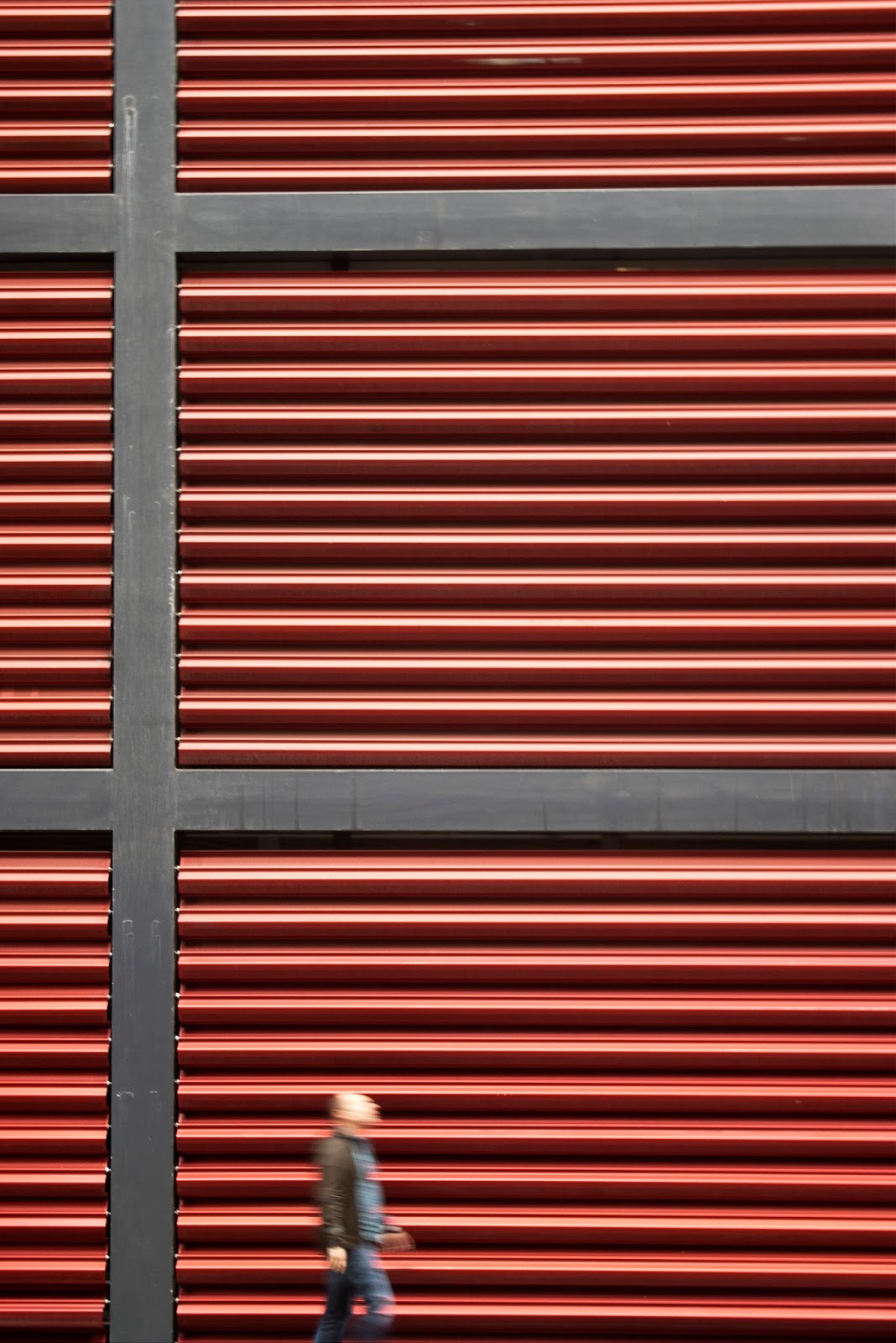
What I like in this shot is the "graphic" background with its sense of scale and movement given by the walking person.
I really enjoyed this exercise, and was very happy with the finished result. 
The image clearly shows a single figure in the frame and I carefully framed and edited the image in such a way as to ensure a technically strong image where the subject was not in a prominent position, yet stood out, thus creating interest for the viewer.

Monday, March 23, 2015

Exercise 18: How space changes with light


This exercise requires to take one location where I can conveniently return a number of times in different lighting, and photograph on each occasion. 
To get full value from this exercise, I am supposed to make two variations of photograph. 
In one, set the camera up in exactly the same position each time. 
In the second, see how the different lighting conditions suggest different viewpoints and compositions. 
The way the shadows fall, for instance, will create different masses of dark and light. 

For this activity I needed a building that was easily accessible at a variety of times of day.  
Therefore, I decided to go with the main building at the reception of the hotel I was in during my recent holidays at the Republic of Maurice. 
There I had indeed arbitrary access and could create the following sequence of images: 

Image 1.


f 3.2, 1/40 sec, ISO 100, 24 mm 

At the earliest time of day, 7:15am the light is soft and the place dimly but evenly lit.  

Image 2.


f 8, 1/250 sec, ISO 400, 24 mm 

As the day goes on the place gets far brighter with quite a harsh white light.  
What is curious is that the intensity and strength does not drop very much as the sun crosses from East to West, it is only after around 6pm that the light starts to soften and the camera struggles with the exposure.  

Image 3.


f 2.8, 1/10 sec, ISO 12800, 24 mm 

By 9pm the light is gone and all that can be seen is the artificial light of the corridors. 

Each photograph is taken from the same vantage point and with as near as I can make it the same framing.  In each of the following images taken I have not enhanced the images in post processing.

I also wanted to capture and compare how light alters a space, and how the tones create this.
I took my images at midday and then later in the evening when different tones were created by the tungsten evening light. 
By day this can be a very busy area but by the evening it is often quieter.
I wanted to use the artificial light to enhance this calmer mood and contribute to the final image. 
Light alters the colour spectrum throughout the day, often not perceived as much by the human eye, which is adept at adjusting quite quickly. 
The WB setting alters how the camera records tones and what setting to use is also important to consider if colour is integral to how a scene is intended to be represented. (One big advantage of shooting Raw is if a mistake is made at the time of shooting at least the WB can be adjusted if needed).

Image 4.


f 5, 1/125 sec, ISO 100, 24 mm 

Image 5.


f 2.8, 1/40 sec, ISO 2500, 24 mm 


Saturday, March 14, 2015

Exercise 17: The user's viewpoint

For this exercise, I am supposed to choose two or three buildings or spaces designed for a particular activity that is undertaken from a specific, distinctive, position.
For each location, the aim is to take one or more photographs that attempt to capture the user’s point of view considering height, orientation and lens focal length (which controls the angle of view).

Image 1 is taken from the swimming pool of my hotel in the Island of Mauritius.
The user's point of view is easily identifiable at the level of the water.
However, such a swimming pool is definitely not conceived for swimming, but more to relax and refresh.
Therefore, with my photo I wanted to convey a feeling of relax, focusing the image on the decorative path of stones at the edge of the swimming pool which lazily leads to a blurred paradise in the background made of palms and of a colonial style cosy patio.
The perspective of the photo is supposed to suggest that, despite I am in a swimming pool, I am not using it for sports purposes, but just with the desire of evasion.
With this aim, in the post production I enhanced the post-crop vignetting, decreased the clarity in order to soften the image, increased slightly the temperature and of course cropped it properly.

Image 1.


f 8, 1/250 sec, ISO 100, 26 mm 

Image 2 was shot at the market place of Port Louis, the Island of Mauritius's capital city.
The look and posture of this trader looks to me extremely interesting, above all compared with the empty shelf in front of him.
He has got almost nothing more left to sell and he looks at me with a sort of regret.
The point of view of the photo is the one of his customers and I appreciate the perspective enhanced by the shelf with its lonely price tag.

Image 2.


f 2.8, 1/30 sec, ISO 400, 24 mm 

Image 3 was taken in a hotel room.
The user's point of view is obviously the sleeper's. 
I like very much the light that the perspective manages to make appreciate.
I opened the "shadows" and the "highlights" in the post production and I got a clearer photo that, in my opinion, is able to well underline a sort of oneiric atmosphere.
The lady sleeping deeply is almost caressed by the soft light coming from the window and reflecting on the different shades of white of the room.
This perspective makes also possible to see better the light on the hair and on the face and back's profile.
I really like this shot.

Image 3.


f 8, 0.8 sec, ISO 100, 26 mm 

Friday, March 6, 2015

Exercise 16: Exploring function

This exercise asks to choose any interior space, either domestic or public, and consider it from the point of view of its function.
First I am supposed to note what I think the space ought to be doing — a short list.
Then consider how well I think it succeeds.
Forming a point of view is important, because it will influence how the I decide to photograph the space.
Having made the analysis, I am supposed to make a carefully considered photograph of the space in order to put across the way it works — or should work — for the people who use it.

Recently, I have been on holiday at the Island of Mauritius and for this exercise I chose to photograph the interior of an Hindu temple in the Grand Bassin.
The Grand Bassin is a lake situated in a secluded mountain area in the district of Savanne, deep in the heart of Mauritius and it is a holy lake for Mauritian of Hindu faith.
It is said that the water inside the lake communicates with the waters of the holy Ganges of India.
The Hindus of Mauritius declared the Grand Bassin as a Holy lake.
Beside the lake there is a temple dedicated to Lord Shiva and other Gods including Hanuman and Lakshmi.
The Hindu community performs there a pilgrimage every year and I was lucky enough to be there at the right moment.

What space should be doing.
- Generate interest in the religion.
- Display in an interesting and attractive way the religious activity.
- Be appealing to all ages.
- Provide a safe “home” to its users.
- Provide a convivial atmosphere in which successful interaction between believers and priests can take place.

How well it succeeds.
Although it looks small the temple is fascinating and contains a really diverse collection, including some colourful votive offerings brought by local people.
It has a really relaxed and intimate atmosphere, helped by the knowledgeable voluntary staff who run it.
Overall, I think the temple well succeeds in its function and even I, despite not being Hindu, was fascinated by the intense activity and the atmosphere I found at the Grand Bassin.

The exercise itself has emphasised the importance of having an idea of what I want to capture and why before I press the shutter.
Sometimes this will be obvious, sometimes it will take more thought, but in the two cases I have taken shots that I would probably not have considered without that discipline.
My biggest difficulty was deciding how to photograph the temple from a users point of view, and how it works as a usable space.
I considered a few viewpoints that I felt would demonstrate this aspect.
I wanted to include the votive offerings within the frame as they are very important to the purpose of the space.
I decided to take my image from outside looking towards the altar area in an attempt to show the heterogeneous and informal nature of the conference.
I feel that the space works well from a users point of view.


f 3.2, 1/50 sec, ISO 100, 24 mm 


Monday, June 30, 2014

Exercise 15: A public space

For this final exercise, I am supposed to transfer my attention from an organised occasion to a semi- organised public space.
Instead of a single event, there will be a variety of things happening, even if not all of it is particularly active or focused.
I am requested to try to capture the sense of varied use — how people make their own personal or small-group activities within the same general area.

Recently, I spent a couple of days at the Parc Animalier de Sainte-Croix (close to the French city of Strasbourg), a fantastic park of about 1,200 hectares where my kids enjoyed a very exiting holiday.
During that days spent in the nature I decided to take advantage of my free time in order to shoot the images for the exercise 15.
I considered the public space of such a park as a perfect and original location for this exercise.
I am rather satisfied by the quality of the photos that I selected amongst the about 500 shots I took.
However, I have to admit that I would have preferred to find more people and activity to photograph, but as the park was almost empty (we were there in the middle of the week and the school holidays in France have not began yet) I was obliged to take mainly the persons who came with me.

Image 1.


f 5, 1/100 sec, ISO 100, 24 mm 

"Here she is, papa!" 
I like Image 1 because it depicts the unbounded energy of a child in a park.
It goes beyond the photo, it passes through a two-dimensional image and it becomes a driving force that pulls the narrative of a shot.
Moreover, I adore the dirt on the hand sneaking into the photo. 
It clearly tells about the intensity of a day lived without saving a single drop of energy.

Image 2.


f 4, 1/100 sec, ISO 100, 45 mm  

The profile and the dress of the little girl sitting on her father's shoulders makes me think about Little Red Riding Hood.
Even more if I think that she is in front of a pack of wolves!
It is indeed a pity I did not have the reflex to change my f stop from 4 to 22 in order to have the animals on my shot.

Image 3.


f 9, 1/500 sec, ISO 100, 51 mm  

The heat and the fatigue were omnipresent.
Image 3 depicts the two.
I like the background and its colour enhancing the sense of heat, but I also appreciate the posture of the boy who is slowly and almost unconsciously getting rid of his rucksack. 
I think that also the wet t-shirt helps adding drama to the shot.

Image 4.


f 4, 1/80 sec, ISO 100, 45 mm  

Image 4 is not a strong image, but I think it has merit to well illustrate the major activity in such a park: looking and wonder.
The tourist (no doubt she one with such a dress!) looks at the dazzling landscape in front of her and I can almost perceive her wonder in her eyes.
I like the graphic, but not necessarily the light of this shot (the burned central stripe).

Image 5.


f 10, 1/400 sec, ISO 100, 34 mm  

This and the next are my favourite shots of this exercise.
Feet and shadows are the central subjects for both.
In Image 5 I like above all the shadows which play a sort of graphic design on the wooden floor and recall to me a game of embroidery.
I doubted long time during the post production regarding the clarity, vibrance and saturation of the image, particularly for the shadows.

Image 6.


f 7.1, 1/200 sec, ISO 100, 24 mm 

In Image 6, the combination of flashy colours, shadow and grey asphalt fascinates me.
The subjects are the same than the ones in previous image, but here I find the narrative stronger.
I think that the colours and the posture of the feet and the body in the shadow transmit a sense of movement, a kind of a soft "rave party" energy that I really like.
I also think that the light vignetting of the post production enhances the general feeling of the shot.

Image 7.


f 7.1, 1/250 sec, ISO 100, 37 mm  

Looking at image 7, I wonder what is more tiring: the heat or the endless run of the children? 
Probably both. And the photo witness both rather well.
I left intentionally the right part overexposed in order to stress this effect.

Image 8.


f 7.1, 1/250 sec, ISO 100, 24 mm  

I like this shot for its contrasts.
The colours, green and red; the wires, the headphones and the pipes; the dress in the heat.
I do not like very much the background (above all the concrete behind the lady), but this is a true quick street photography shot and I did not have the time to choose a better place.

Sunday, June 29, 2014

Exercise 14: An organised event

For this exercise I am requested to research, prepare in advance and look for an organised event at which there will be plenty of people and in which I can confidently expect to be able to photograph freely and with some variety.
An event at which spectators are in seats will not do; one in which people move around will be more useful.

The 23rd of June is the National Day in Luxembourg.
Being the most important organised event of the year, I decided to take advantage of it and use it as the subject for this exercise.
During the afternoon I shoot more than 600 photos and the followings are the ones I consider to be the most appropriate for the brief.
The last four images are my favourites.

Image 1.


f 5, 1/200 sec, ISO 100, 70 mm 

Here it is: Luxembourg and its formal and conformist look.
A small village elected to the status of a country by historical hazard.
I consider the narrative of the shot to be rather interesting, above all for a Luxembourgish resident who can appreciate the peculiar milieu of the photo.
I think it is a pity I did not have the time and the reflex to use a higher depth of field. 

Image 2.
  

f 5, 1/200 sec, ISO 100, 70 mm  

What I like the most in this rather elementary shot is the look of the green lady. 
Despite her extra-terrestrial appearance, I find her look very human.

Image 3.


f 3.5, 1/60 sec, ISO 100, 42 mm  

I have to admit that I have been taking several shots from this peculiar spot.
I adore the installation done in the main street of Luxembourg City which consists in a number of colourful umbrellas hanging in the sky.
Their reflection on the black background in a specific spot of the street, created a sort of dreamlike atmosphere that charmed me.
Unfortunately, I do not think that the narrative of the photo is as strong as it should be.

Image 4. 


f 6.3, 1/160 sec, ISO 100, 24 mm  

I know, very likely Image 4 can be considered out of the scope of exercise 14.
However, I like it a lot.
I like the image in itself for its simplicity, the frame, its four clear "points" (the slipper, the two cigarettes boxes and the paper), the line of cobblestone sidewalks ending where the slipper is.
I also like the narrative which well depicts a street after a national party and the questions it leaves unanswered.

Image 5.


f 5.6, 1/160 sec, ISO 100, 24 mm  

I find the red-green colours pair of the image very interesting. 
Their combination with the sky looks to me rather charming too.
However, the man coming out of the trash-bin with all "his" chaotic party of people seems to me the most relevant characteristic of the shot. 
Funny narrative indeed!

Image 6.


f 5, 1/200 sec, ISO 100, 63 mm 

What the hell is this kid doing?
I do not have the answer, but I like this kind of crazy, colourful, handmade installation that manages to attract all the attention of the young boy and harmoniously melts its colours with his in a unique blend of tints.

Image 7.


f 7.1, 1/400 sec, ISO 100, 70 mm 

The last image is supposed to close the National Day "reportage" with its long late afternoon shadows and the two last Luxemburgers going back home.
Besides the very "clean" background, I appreciate the way the couple walks away almost marching together, like they saw the soldiers doing earlier in the day.  
The man's hand expresses a sort of formal tension that recalls to me the look of the lady with the red hat in Image 1. 

Monday, June 9, 2014

Exercise 13: Standard focal length

As in the previous two exercises, I am requested to concentrate on shooting with one focal length.
In this case, having a full-frame DSLR, the focal length is supposed to be between 40 mm and 50 mm.

Image1.


f 5.6, 1/160 sec, ISO 100, 45 mm

This photo and the following are my favourite shots for this exercise.
In Image 1 I like very much both the light and the narrative.
I believe that the light I managed to catch is very pure and it gives to the picture a sort of tridimensional feeling.
I think that the clouded evening sky is the key for this peculiar, magic light.
Moreover, the light expresses very well the narrative which depicts a thoughtful lady looking at Paris.
As her face is hidden, we do not know what she thinks.
And this is exactly the charme of the photo.
We can let our thoughts run like a look that goes beyond a hill, beyond our limited restrictive visual experience, towards the infinity of our imagination.

Image 2.


f 2.8, 1/50 sec, ISO 320, 50 mm

I think that the look and the posture of this shop assistant is simply great.
When I entered the shop and I saw him I had to tell him he was wonderful and I asked him if I could take a photo.
I know, this goes against the exercise's constraint "people unaware", but his long beard, his black undershirt and his alluring look deserved a shot and the only way to capture him in his shop was asking him.
Moreover, I believe that the French text over his head saying "Une fraicheur éclatante (A sensational freshness)" is the perfect title for the image.

Image 3.


f 4, 1/100 sec, ISO 100, 50 mm

In Image 3 I appreciate the visual connection between the graffiti and the little girl.
This gives me a kind of impression that the city is under the control of the children.
As a matter of fact, who else than a child could draw a "Lego" soldier on a wall?

Image 4.


f 5.6, 1/250 sec, ISO 100, 50 mm

When I arrived at Pompidou, the drunken young man appeared from nowhere and stood in front of me speechless.
His doubtful expression and the absence of words seemed to me as the simple execution of an order.
"Shut up, and do not disturb our society" stated the huge drawing on the wall behind him.
While I like the narrative of this photo, I do not really appreciate the light which I find to be not charming enough.

Image 5.


f 2.8, 1/50 sec, ISO 1600, 50 mm

In 1968, Henri Cartier-Bresson took the black and white photo depicted in Image 5 during the strike at the Renault car plant in Billancourt (France).
The only thing left in common between the modern fashionable lady looking at it and the old striking workers in HCB's shot is the red colour of her scarf.
It is a pity that 50 years later things are still not getting better at Renault.
Besides the narrative, I like how the photo is framed and its warm temperature.

Image 6.


f 3.2, 1/500 sec, ISO 100, 40 mm

What attracted me in the French man of Image 6 was his smart casual dress (very French indeed) and his stressed look.
He was clearly waiting for someone who was late.
I like the tension in his eyes and his hand ready to dial on his mobile the late coming's number.
I also appreciate the shop sign behind him which recalls once more the transalpine atmosphere of the shot.


Sunday, June 8, 2014

Exercise 12: Close and involved

After having tried with the longest focal length possible in exercise 11, this one asks me to switch lenses (or adjust focal length) to the widest angle that I have.
A true wide- angle, judged from its visual effect, is around 28 mm or less.
One of the uses of a wide- angle lens is to be able to cover a large subject area in one shot, but here I am requested to concentrate instead on using it close to people, and try to achieve a sense of putting the viewer right inside the situation.
From the point of view of comfort and confidence, this is quite a challenging way to shoot.
As with the previous exercise, I have to note down both the problems and the advantages created by working with a wide-angle of view from very close to the people I am photographing.

All the images have been taken with my shortest focal length: 24 mm.
The main challenge for such a wide angled view is that it can pull the viewer right into the centre of the scene.
It can also slightly distort the facial features of any individual right in front of the camera, creating a flat perspective.
Following my natural approach to photography, I really enjoyed taking the following shots.
I like the way this angle of view draws the viewer into the scene, it creates quite an intimate image, a feeling of being part of the activity.
A day of walk through the streets of Paris gave me the opportunity to get really close to the people while “snapping” anyone and anything.

Image 1.


f 8, 1/320 sec, ISO 100, 24 mm  

"L'amour est mort" (Love is dead) is my favourite shot.
First of all, I find the photo very "graphic" with its horizontal strips created by the strong sun light.
I like the text, written in small letters, probably by a girl.
It is a cry of desperation, intense, black like the death.
However, it is somehow discrete, with its small letters covering a small part of the large wall, almost with no intention to disturb. It seems to say: "I suffer, I have to shout it on a wall, but not too loud".
And then I like the lady passing by, lost in her "shopping" thoughts, who gives a sort of spin, a soft movement, to the image and underlines people's indifference for this (sentimental) pain.
Love is dead, but the show must go on!

Image 2.


f 5, 1/100 sec, ISO 100, 24 mm  

Frankly speaking I do not know what went wrong with Image 2.
In post production, I could have easily corrected the two black areas on the top left and bottom right corner of my photo, but I like this mistake.
It gives a kind of mystery to the shot, like if I was looking into a keyhole.
I like also the light blue colour and the reflex in the window: a dreamlike photo.

Image 3.


f 2.8, 1/40 sec, ISO 1250, 24 mm  

In the corridors of the Paris's underground you can even find a 12 elements Russian orchestra playing traditional music.
But what hit my attention more than musicians were the ladies taking photos of them.
The delicate gesture of a posh lady's hand adorned with a heavy ring taking a shot of street photography made me wonder if I am really doing the right thing ;-)

Image 4.


f 8, 1/250 sec, ISO 100, 24 mm  

 General De Gaulle heading France towards its bright future is one of the most iconic images of the "Republique".
Image 4 would like to express my humble doubt regarding the youngster French more busy in looking at their Ipods and voting Front National than in following the basic values of their great nation.

Image 5.


f 5, 1/100 sec, ISO 100, 24 mm  

I like the cut of Image 5 more than the people.
The white, the blue, the yellow and the feeling of movement.
I like Barbès, one of the most popular areas in Paris.

Image 6.


f 9, 1/320 sec, ISO 100, 24 mm  

I think that the footsteps associated with the walking girl of Image 6 convey a sense of sympathy in this photo.
The sun light is maybe too strong, but, in my view, it helps to stress the general feeling of positive attitude and optimism of the image. 

Image 7.


f 4.5, 1/80 sec, ISO 100, 24 mm 

This boy and his cap is the most well representative French I found during my stay in Paris.
I like very much his smile, his hands in the pockets; everything fits to the stereotype we have of a young French person.
I also appreciate the typical urban background that, I believe, puts in value very well the subject.
   
Image 8.


f 22, 1/20 sec, ISO 100, 24 mm 

Image 8 is supposed to underline the street art creativity.
The shot taken in front of a theatre is supposed to depict the possibility to make art with almost anything in this world.
Beside the message, I really appreciate the long shadows of the image.

Saturday, June 7, 2014

Exercise 11: Standing back


This exercise asks to select a medium-long focal length, ideally between 80 mm and 200 mm full-frame equivalent, and go for a street photography shooting session.
Then it asks to note down what practical difficulties I encountered and what special creative opportunities I found that a long focal length and distant position have given me.

Recently, I gave away my old Pentax and I bought a Canon EOS 5D Mark III with a 28-70 mm Sigma lens.
The Pentax body was equipped with a standard lens 18-55 mm and I also had a 70-300 mm Sigma lens that I rarely used.
One of the main reason why I enjoy street photography is because it is a mean to get closer to people, to express myself through them and their moment of life.
For this reason and according the experience I had with my previous camera, I did not feel the need to equip my new camera with a longer focal lens.
Therefore, I did this exercise with the longest focal lens I currently have: a 70 mm.

However, based on my previous work with the 300 mm lens I can tell that the major difficulty I encountered was the fact that my images were often blurred.
Indeed, something to consider when shooting at this focal length is to either use a tripod, or use a fast shutter speed to prevent out of focus and blurry images.
Another issue I found of being such a distance from my subject  was not really able to see them very well. Until I looked at  my images on the computer I was not too sure if my subjects expression was what I liked, or wanted.
And finally I did not feel very comfortable in playing the paparazzi.
I did not see any particular creative opportunities using an extreme long focal length that excludes the surrounding areas of clutter and somehow removes critical information about a street scene.

The following photos have been taken during my recent trip to Paris.

Image 1.


f 5, 1/200 sec, ISO 100, 70 mm 

Image 1 is my favourite shot.
The cut, the perspective, the reflection, the mirror, the fingers and her thoughtful expression are the main elements of the composition of this shot that I appreciate for its spontaneity. Both the photographer's and the subject's.  

Image 2.


f 5.6, 1/160 sec, ISO 100, 70 mm 

Even if far from Henri Cartier-Bresson's "decisive moment", Image 2 is meant to be a sort of allusion to the great French photographer and the exhibition I visited.
Would HCB have taken the old lady that way?
Probably not, but I had the pleasure to do it under his eyes!

Image 3.


f 7.1, 1/400 sec, ISO 100, 70 mm 

The light in the corner was an irresistible call to shoot.
When the little boy walked slowly into the frame I had to take that photo.
I never take photos of children for obvious reasons, but I liked so much the relation between his almost lost expression, the way he seems to walk on the water, and the spot of light above him.
His mother's look was proud of both of us. 

Image 4.


f 2.8, 1/80 sec, ISO 125, 70 mm 

Stress and smoke under a finally sunny Paris.
I appreciate Image 4 for her twisted peace-less legs and the spot of rainbow coming out from the window's glass: "Il y en a qui bosse!"

Image 5.


f 4, 1/125 sec, ISO 100, 70 mm 

I understand that the execution of the shot is not on the same level than the strong narrative of Image 5.  
The photo is probably too blurred, but I think it was worth to post it.
In my view the marching feet and the shopping bag express rather well the concept of indifference.
This is street photography too.

Image 6.


f 5.6, 1/250 sec, ISO 100, 70 mm 

I like the diagonal cut in Image 6 because it gives a sort of spin to the cool subject ready to step into a pompous French building.

Image 7.


f 7.1, 1/400 sec, ISO 100, 70 mm 

I appreciate the composition of Image 7.
The ladies and the trees, all seem to look in the same direction.
I also like the light, the shadows, the vertical lines above and the yellow horizontal ones below them.

Image 8.


f 4, 1/160 sec, ISO 100, 70 mm

I appreciate that this shot is not really of "people unaware" as the exercise would require, but I liked the sudden complicity I had with this lady preparing her shop window.
I like her smile and the text on her window that can be easily associate with the reflection of a car.