Showing posts with label Exhibitions. Show all posts

Thursday, April 2, 2015

Exhibition - "Flashbulb Memories, Ash Grey Prophecies" by Geert Goiris

During a recent trip to Amsterdam I had the opportunity to visit the exhibition "Flashbulb Memories, Ash Grey Prophecies" by Geert Goiris displayed at the Foam (Fotografiemuseum Amsterdam), a photography museum with four different exhibitions at any given time in which different photographic genres are shown, such as documentary, art and fashion.

Goiris occupies a unique position in the field of contemporary photography.
His layered photos of sublime landscapes, modernist architecture and reserved portraits possess a strange, unreal beauty with no perception of time and space, and are vaguely reminiscent of the visual language of post-apocalyptic feature films.
And yet everything that Goiris photographs is real. Nothing is photoshopped.
Many of his photos feature reminders of man's attempts to domesticate nature.
Goiris creates powerful images, in which he combines an almost universal perception of beauty with a subtle frisson of danger.
As well as being mental images, his photos are records of reality that generate room for stories, associations and suspense in the area of tension between fact and fiction.
The exhibition is entirely without daylight, and the oppressive atmosphere is intensified by spatial interventions and interaction between slide shows, framed photos of varying dimensions and enormous prints.

I gathered hereunder the photos I consider the most representative of the exhibition I visited.
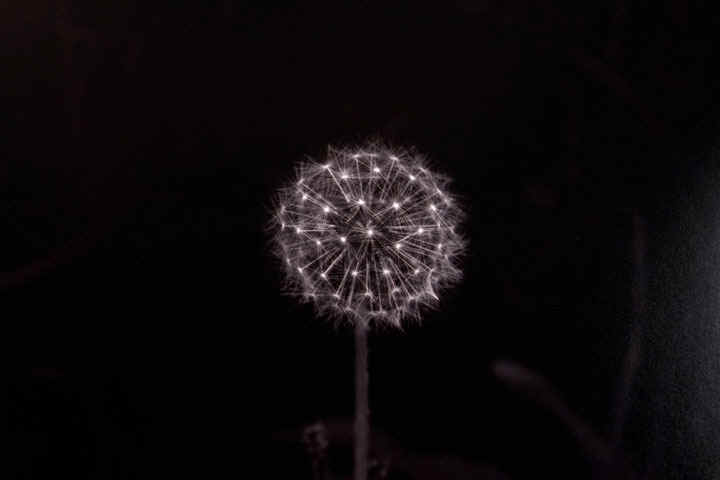


I appreciate very much the simple, pure graphic touch of this shot, which was shown at the very beginning of the exhibition.
I like the very interesting light effect that the artist managed to create and I believe it gives to the picture a touch of magic.
I do not necessarily like the light grey shadows that can be perceived in the right part and on the central bottom of the frame, because I find that they distract the look from the real subject.
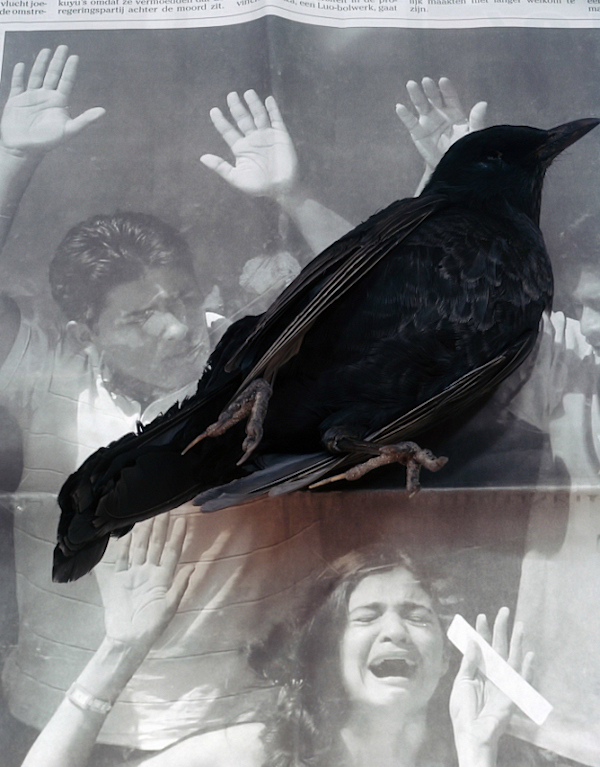


This is definitely my favourite photo.
The narrative of this shot is very intense and I think that this juxtaposition is simply perfect.
What are the children doing? Why did the bird die? What is the relation between them? Why so much pain? 
All these questions come to my mind and make me travel with my mind through the photo again and again, looking for more details, more answers.
This is exactly what a photographer should make me do. Great!


The rhino in the fog is dark and somehow scares me.
However, it is inoffensive, the threat is no longer there as it is too late: the powerful animal is gone, like eaten by the fog.
Very nice shot which won the Deutsche Borse award!


Goiris explains that the choice of his subjects depends. 
Sometimes they choose him instead of the other way around. 
In this series Resonance, for example, most of the photographs were made while he was traveling without a specific preconceived target, but with a camera. 
So when he came across inspiring people, places, animals, objects, atmospheres, or light conditions, he reacted on these in an improvised way. 
As if the photograph was already there in front of his eyes, and all he had to do was to record it.




Saturday, June 21, 2014

Exhibition - Henri Cartier-Bresson

"To take a photograph is to align the head, the eye and the heart. It's a way of life." (Henry Cartier Bresson)

HCB is my favorite photographer and recently I had the chance to attend his exhibition in Paris.
On from 10 February to 9 June in Paris's Centre Pompidou, it brings together 350 photographs taken between the early 30s and the end of the 70s.
Look back on the 20th century through the lens of HCB, and it's all there: the jazz age of the 1920s, colonial Africa, the Spanish civil war, developing human rights, capitalist expansion, two world wars, Ghandi's funeral, decolonisation, Mao, the first man in space, America booming, student protests, the collapse of the Soviet bloc – all captured in black and white.
The ambitious show, which aims to showcase his "incredible eye", has been made possible by a collaboration between the Henri Cartier-Bresson Foundation and Magnum Photos.

The Pompidou's exhibition underlines the reach and diversity of his images, where other retrospectives have tended to focus on the unity of the work.
By placing his photography at the roots of the surrealist avant-garde – not surprising, given the location – the exhibition explores all the ramifications of this idea – from social engagement to visual experiences, from Parisian shop windows to American baseball matches and from Communist journals to Mexican alleyways.


HCB was the patient photographer: he knew how to wait for the decisive moment.
He was the photographer with perfect geometry: the formal harmony of his shots is masterly.
HCB was the discreet photographer: he never intruded into the scenes he photographed, so he didn’t interfere with what was happening.


Dubbed, and with good reason, “the eye of the century”, HCB created many photos that are classics of twentieth-century photography.
He knew how to catch the decisive moment, the spontaneity of everyday events as they occurred, and record its immediacy for all time.
As his famous and much-repeated quote has it: "Photography is, for me, a spontaneous impulse coming from an ever attentive eye which captures the moment and its eternity."
It’s a goal that only a few photographers have reached, and then only with a few lucky shots.
HCB though seemed to touch the heights and pin down the world in every shot.
Always in the right place at the right time, HBC photographed historically important events as they were happening – the political demonstrations in Paris in the 50s, Gandhi’s funeral in India and the deportation camps at Dessau – but also the small stories you find in town squares – the sensuality of a smiling prostitute or the happiness and joyfulness of children in the street.


The wide selection of his work I saw in Paris remembered me that, as HCB often said, the beauty of a photograph lies in the moment when it’s taken.
He wasn’t greatly devoted to the photos he had created, but rather had a hunger for new images and visions.
He was always on the hunt for his best photo, the one he was about to take.


Exhibition - "Robert Mapplethorpe"

During my recent stay in Paris I had the opportunity to visit two very interesting exhibitions.
The first one was a retrospective of Mapplethorpe’s work which featured some two hundred and fifty images exploring a range of themes.
They covered every aspect of Mapplethorpe’s art - bronze bodies and flesh sculptures, geometric and choreographic, still lives and anatomical details, bodies as flowers and flowers as bodies, court portraiture, night photography, and eroticism, soft and hard, self-portraiture in all its forms.


Robert Mapplethorpe - Vase

I appreciate the pure lines of the shot.
The research of aesthetic perfection in this image is what made Mapplethorpe a great artist: strong narrative (in my view, missing in this instance) and perfect technical graphic execution.
Robert Mapplethorpe was one of the great masters of art photography.
He was an artist with an obsessive quest for aesthetic perfection.
A sculptor at heart, and in his imagination, he wanted “people to see [his] works first as art and second as photography.”

The works from the photographer’s early career, which close the exhibition, revealed how the path taken by his art was already mapped out in his first Polaroids.


Robert Mapplethorpe - Andy Warrol

Over and above the erotic power that made Mapplethorpe’s work famous, the exhibition presented the classic dimension of the artist’s work and his search for aesthetic perfection from the early 1970s to his untimely death in 1989.
He was an admirer of Michelangelo: he championed the classical ideal - revised and reworked for the libertarian New York of the 1970s - and explored sophisticated printing techniques to create unique works and mixed compositions, which he framed in unusual ways.
The exhibition opened with Mapplethorpe’s self-portrait with the skull-head cane: the image of a young man, already old, tragically cut down in the prime of life by AIDS.


Robert Mapplethorpe - Self Portrait

I believe that his portrait reveals how the master shadows gave free rein to his imagination.
"Like a modern day Orpheus, beyond death, he seems alive - although only just - yet already in the afterlife of his work, beckoning us with his satanic cane to follow him into the underworld of his life, in search of his desire."


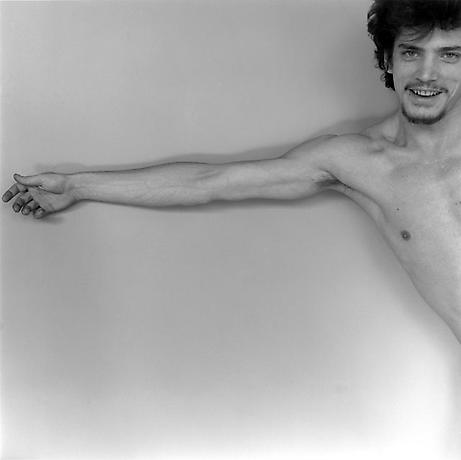
Robert Mapplethorpe - Self Portrait

This self portrait was my favourite image.
The frame is fantastic, with his left eye and the finger slightly cut, the head just in the up right corner, his smile looking at you depicting the intensity and the lightness of the moment.
I simply adore this shot!

“Photography and sexuality have a lot in common,” explains Mapplethorpe.
“Both are question marks, and that’s precisely what excites me most in life.”
Exploring the photography of the body, he pushed it to the limits of pornography, perhaps like no other artist before him.
The desire in these images - often the photographer’s own desire - also reflects life in New York, as lived by some, in the 1970s and 80s, at the height of the sexual liberation movement.
“I’m trying to record the moment I’m living in and where I’m living, which happens to be in New York. I am trying to pick up on the madness and give it some order.”


Robert Mapplethorpe - Self Portrait

Saturday, April 19, 2014

Exhibition - "Paparazzi! Photographers, stars and artists"

Centre Pompidou-Metz dedicates a very well prepared exhibition to the phenomenon and aesthetic of paparazzi photography through more than 600 works (photography, painting, video, sculpture, installation, etc.).

Covering fifty years of celebrities caught in the lens, "Paparazzi! Photographers, stars and artists" considers the paparazzo at work by examining the complex and fascinating ties that form between photographer and photographed, going on to reveal the paparazzi influence on fashion photography.

By associating some of the genre's leading names, including Ron Galella, Pascal Rostain, Bruno Mouron, Tazio Secchiaroli, with reflections on this modern-day myth by Richard Avedon, Raymond Depardon, William Klein, Gerhard Richter, Cindy Sherman and Andy Warhol, "Paparazzi! Photographers, stars and artists" sets out to define the paparazzi aesthetic.

The exhibition is divided into five parts: Introduction, Photographers, Stars, Artists and Conclusion


1. RED CARPET (INTRODUCTION)

The visitor steps into the exhibition space to be immediately confronted with paparazzi flashes from an installation by Malachi Farrell, titled Interview (Paparazzi).
Photographs showing a pack of paparazzi "hunting their prey" create a mise en abyme that plunges the visitor into a new role as a star, while giving them a taste of the pressure celebrities are under.


Malachi Farrell - Interview


2. PHOTOGRAPHERS

The profession of paparazzo is more complex than it seems.
Paparazzi must be ingenious, mounting what are often delicate, high-risk operations. They each have their tricks of the trade and tales to tell which together form the grand story of "paparazzism".
In a series of interviews with paparazzi, a presentation of their tools (including spy cameras, long lenses and disguises), photographs by Francis Apesteguy, Olivier Mirguet, Jessica Dimmock and Christophe Beauregard, and an excerpt from Raymond Depardon's Reporters film, this section goes behind-the-scenes of the paparazzi.


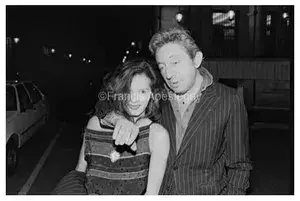
Francis Apesteguy - Serge Gainsbourg

The figure of the paparazzo was invented by Federico Fellini in 1960.
The name is a contraction of "pappataci" (mosquitoes) and "ragazzi" (boys).
The paparazzo is portrayed as a post-modern anti-hero.
Since La Dolce Vita, he has become one of the mythical figures of popular culture.
Excerpts from films by Dario Argento, Federico Fellini, Brian De Palma, Louis Malle and Andrzej Zulawski, from the 1930s to the present, reveal the public's perception of the paparazzo as a solitary figure, often down on his luck.
Devoid of morals or scruples, and therefore hard to love, he is the double negative of the war correspondent.


3. STARS

Paparazzo is a male-dominated profession.
Its targets, on the other hand, are almost always epitomes of womanhood.
This section considers the case of eight women – Brigitte Bardot, Paris Hilton, Jackie Kennedy-Onassis, Stéphanie de Monaco, Britney Spears, Diana Spencer and Elizabeth Taylor – to show how the style and stakes of paparazzi photography have changed over half a century.


Ron Galella - Jackie Kennedy-Onassis and her husband

Celebrities are not just helpless victims.
When they spot the paparazzi, they can choose to play along with them and allow themselves to be photographed or not, in which case their reactions can range from a polite refusal to physical aggression.
They can also be a willing accomplice, going as far as to invent their own way of escaping the star system and its constraints.
This section presents celebrities' different reactions to the camera through a series of shots by the twentieth century's greatest paparazzi – Daniel Angeli, Francis Apesteguy, Ron Galella, Marcello Geppetti, Bruno Mouron and Pascal Rostain, Erich Salomon, Tazio Secchiaroli, Sébastien Valiela and Weegee.


Paul Schmulbach - Ron Galella and Marlon Brando, 1974


4. ARTISTS

The paparazzi photo has a recognisable aesthetic, a result of the conditions in which it is taken.
These are on-the-spot, improvised images, with all the consequences this has on their composition: the long lens for distance shots, or the flash for close-ups, flatten the image.
Celebrities shielding themselves behind their hand has become the symbol of media aggression.
Since the 1960s, the paparazzi aesthetic has inspired numerous artists in Pop Art, post-Modernism and more contemporary movements, from Richard Hamilton to Paul McCarthy, including Valerio Adami, Barbara Probst or Gerhard Richter.


Barbara Probst - Stills Gallery

Fascinated by the image hunters’ approach, numerous artists and fashion photographers since the 1960s have stepped into their shoes for one or other project.
Photographers such as Richard Avedon, William Klein and Terry Richardson were first to get under the paparazzo's skin for a series of shots.
Many artists, including the American Gary Lee Boas, English artist Alison Jackson, and G.R.A.M., an Austrian collective, have also collected stars in the same way paparazzi do.
Since the 1980s, women artists such as Malin Arnesson, Kathrin Günter and Cindy Sherman have questioned the artist's celebrity status.


Alison Jackson - The Queen


5. NEWSSTAND (CONCLUSION)

Celebrity magazines satisfy the demand of a media industry which has its own rhetoric and its own, unmistakable page layout.
Through works by Jonathan Horowitz, Armin Linke, Paul McCarthy and Andy Warhol, this last section raises the question of how paparazzi photos reach their audience.


Jean Pigozzi - Mick Jagger and Arnold Schwarzenegger, Hôtel du Cap, Antibes, 1990

Saturday, March 15, 2014

Exhibition - "Izis, il poeta della fotografia" (Izis, the poet of photography)

At the "Spazio Oberdan" in Milan I had the pleasure to visit the exhibition of Izis Bidermanas (1911-1980), better known as simply Izis.
The Province of di Milano and the Alinari's Foundation in cooperation with Ville de Paris (Paris City Council), presented the collection of one of the most important humanist photographer of the XX century.
Born in Marijampolė, present-day Lithuania, Bidermanas arrived in France in 1930 to become a painter. In 1933, he directed a photographic studio in the 13th Arrondissement of Paris. During World War II, being a Jew, he had to leave occupied Paris. He went to Ambazac, in the Limousin, where he adopted the pseudonym Izis and where he was arrested and tortured by the Nazis. He was freed by the French Resistance and became an underground fighter.
Izis became a major figure in the mid-century French movement of humanist photography — also exemplified by Brassaï, Cartier-Bresson, Doisneau and Ronis — with "work that often displayed a wistfully poetic image of the city and its people".
For his first book, "Paris des rêves" (Paris of Dreams), Izis asked writers and poets to contribute short texts to accompany his photographs, many of which showed Parisians and others apparently asleep or daydreaming. The book, which Izis designed, was a success. Izis joined Paris Match in 1950 and remained with it for twenty years, during which time he could choose his assignments.
Among the numerous books by Izis, Gerry Badger and Martin Parr have especial praise for "Le Cirque d'Izis" (The Circus of Izis).
Shot mostly in Paris but also in Lyon, Marseille and Toulon, the photographs are "affectionate and nostalgic, but also deeply melancholic" with "a desolate undercurrent", forming a work that is "profound, moving and extraordinary".

The exhibition “Izis, il poeta della fotografia” showed a selection of about 140 photos.
I had the opportunity to discover the intense activity of this photographer who depicted "the dream" with his poetical style that I very much appreciate.


"Homme aux bulles de savon". Petticoat Lane, Middlesex street. Whitechapel, 1950.

This shot was one of the photos shown in the brochure advertising the exhibition and I believe it is indeed one of the most representative of the style of Izis's style.
I simply adore the oneiric atmosphere and the contrast between the (old) man and his gesture typically associated with a child's activity.
The light soap bubbles are also in contrast with the heavy and dark background and cloudy sky.
In my view, the depth of field that leaves the background out of focus plays also a fundamental role in the success of this photo.
Great shot that well deserves to be shown in the presentation of the exhibition.


"Fête", Place de la République, Paris,1950

Here I very much appreciate the frame, the diagonal cut that gives such a sense of freedom.
I can almost feel my stomach going wild with the movement of the carousel and hear the two ladies screaming while their hair fly in the air with their terrified bodies.
Again, in my opinion, the flat background in a cloudy sky gives to the image a sort of oneiric touch, like a timeless instant.


"Carnaval de Nice", Nice, 1956

In this photo I definitely like the narrative.
Who is this boy? Why his body is so tense? Why does he keep the mask and the bag of confetti so gripped, almost hiding them? Did he steal them? Or did somebody want to steal them from him?
The questions are unanswered because the photo is tightly cropped on the boy and the viewer can only remain with the taste of its mystery.


"Sur les quais de la Seine", Petit Pont, Paris, 1954

I believe that the perspective of this shot is absolutely very innovative for the time it was taken.
First of all, it is a very interesting view of a resting body that almost melts itself with the architecture around. 
I needed few seconds in order to understand where was the head of the woman and get the right angle.
Izis takes my look and brings it around this picture like a journey to the discovery of amazing details: the shoes, the pantyhose, the stain on the knee, the "graphic" shadows, the overall position of the body...
Second, I think that he goes very far into an intimate look considering the fact that the shot have been taken in the '50s. And I personally appreciate very much his brave, intimate and intense look.


"Saltimbanques", Lagny, 1959

I personally adore lines!
Lines, ropes, cables, anything that can cut a photo fascinates me.
I like delimitation of spaces, the creation of different areas of visual space that can make a photo extremely attractive.
The lightness of this shot is simply fantastic and this is why it is one of my favourites.


I enjoyed very much this exhibition because, even after 60 years, Izis's photos, with their sharp cut of light and their particular sensibility to the atmosphere, still express a great deal of poetry.
He is definitely a fascinating artist, marked by the difficulty of the exile and by the war, but who kept intact his purely poetic nature.
His photographic style is intuitive, direct and oneiric and, among the humanists photographers that I know, he is one who better managed to allow the viewer from reality to dream.


Friday, February 14, 2014

Exhibition - "Ensemble" (Together) by Denis Darzacq

The exhibition "Ensemble"("Together") at the cultural center "Arsenal" in Metz (France) presents very interesting photos from the series realised by Denis Darzacq. 
Darzacq's project lasted 15 years and shows the reflection of the artist on the often precarious place of the individuals in the contemporary society. 
Even if the his way of photographing evolves, the body appears, since the beginning, as common denominator of Denis Darzacq's researches. 
The artist conceives the body as a real sculpture within the social environment. 
It is social sculpture because the body cannot be extracted from the context with which it interacts. 
The artist in fact uses it as the tool of a criticism of the difficulties and the stigmatisation that certain groups, particularly the young people of the disadvantaged districts or the disables, have still to face in our modern society.
Denis Darzacq's photography points out social's constraints and the contradictions.
He invites to affirm an identity which is more complex than the one imposed by the society and conquer a freedom that is often formally denied.


I personally liked a lot the message of the artist.
I believe that his work is very original and gives a strong input to the viewer hitting prejudices and helping to re-think the way we see the persons that are often considered to be marginal in our society.
He manages very well to discover the poetic side or simply the oddness of the "marginalised" and to express this artistically. 
In parallel with this quest, he is extremely attentive to the different ways the human body relates to the city space. 
I like a lot social documentary and I believe, like Denis Darzacq, that photography should be also used in order to expose social issues. And in my opinion, he did a great job in this respect.
However, I did not necessarily always liked his style of photography.
Sometimes, the narrative of his shots looks to me rather "minimalist" (eg. the last picture I published in my post).
On the contrary, above all in his series with disables persons, it is as if his photography had succeeded in giving new form and meaning "to the compassionate injunction look at disabilities in a new light".